The thing that everyone always misses in these conversations is that screens over buttons is a cost cutting measure, not a first-principles design decision.
It means the UI can be designed and developed mostly independently of the physical controls, which helps reduce rework. I also expect it reduces costs for manufacture and assembly.
I’m in favour of more physical controls, but it surprises me that this rarely comes up. I suppose “people are idiots” is a more appealing explanation.
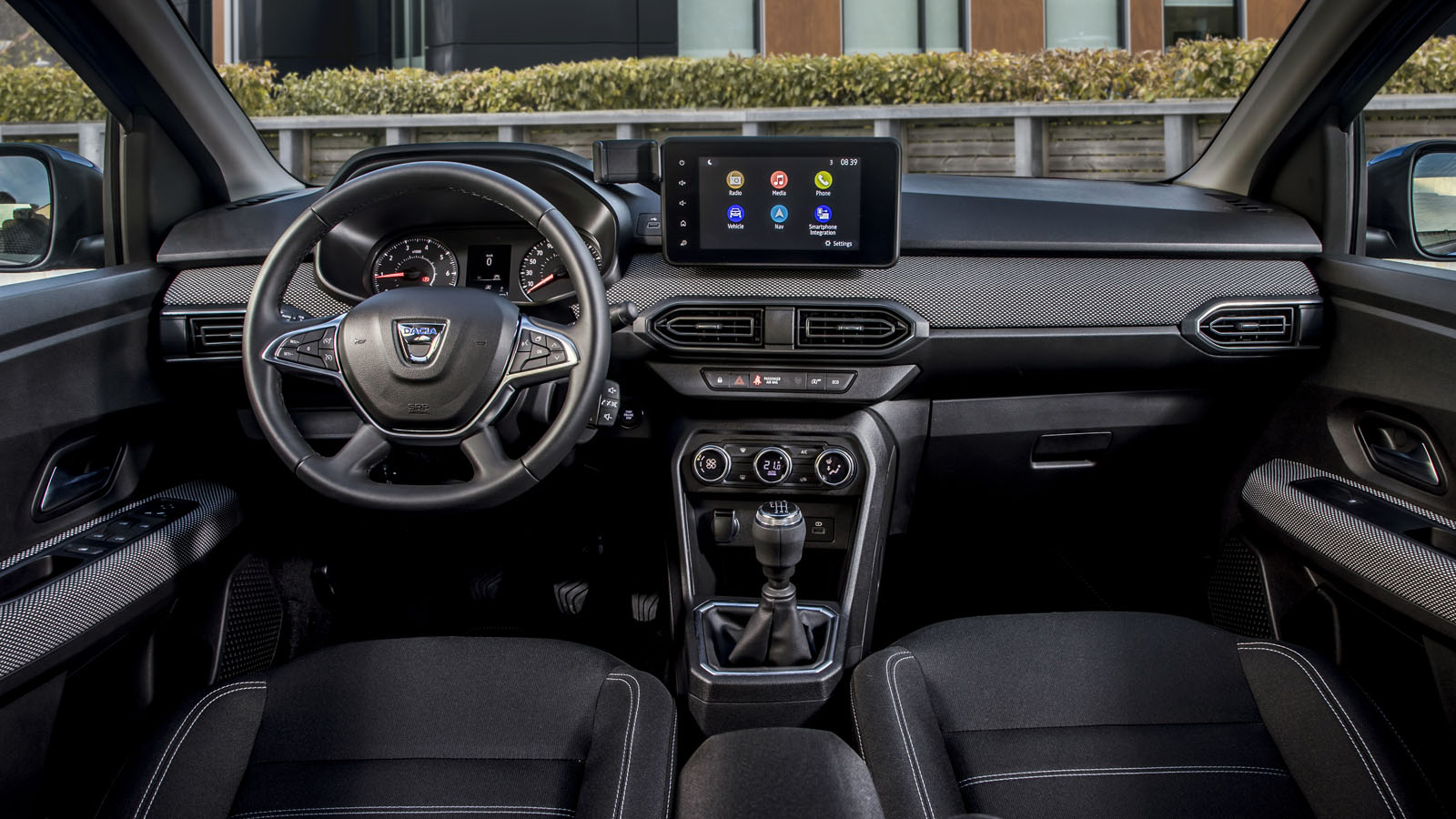
Somehow, the Dacia Sandero has physical controls for climate control and physical buttons on the steering wheel. It manages to do that whilst being one of the cheapest cars you can buy.
Having fewer functions means fewer controls are required. Fewer controls means fewer buttons. KISS tends to promote this.
If it's the choice between $50 worth of buttons and $100 worth of touchscreen, then $50 worth of buttons wins on cheapness.
And at that end of the market, it works (and it makes sense that it works).
---
But at the other end of the market: Common luxury cars have lots of features, and KISS isn't really one of the design goals (if a customer wanted cheap and simple instead, perhaps they'd be shopping for a Dacia instead). Things are still built down to a cost, but there's a greater quantity of those things.
When the choice is between $200 worth of buttons or $100 worth of touchscreen, then $100 worth of touchscreen wins.
> But at the other end of the market: Common luxury cars have lots of features, and KISS isn't really one of the design goals (if a customer wanted cheap and simple instead, perhaps they'd be shopping for a Dacia instead).
It wasn't always like this. Mercedes-Benz used to make high quality, straightforward automobiles without all the inspector gadget james bond crap. See e.g. W123, W124, W126. Luxury meant high build quality, safety, comfort, easy maintenance, and a lifetime of reliable, dependable performance. Not features--you get the same basic features (ok, temperature regulated climate control is kind of novel for the late '70s-early '80s W123). But this stuff was minimal. Now the whole goddamn car is an iphone app. It's disgusting.
The self-leveling hydraulic suspension in the W123 wagon was also a complication. The climate control system was failure prone, but failed in a sensible way--when the control unit failed it would no longer maintain a set temperature, but would still work as an open-loop system. The cruise control "computer" (completely analog device) was also prone to failure. But the thing is all that stuff was implemented simply, reliably, and with an eye towards service and maintainability. Maintaining the systems on a W123 was easy. I did it for almost a decade. It was a fancy car, but in a sensible high-quality way. It was built to be understood. There were excellent printed, bound shop manuals. It was obvious that an immense amount of thought went into the UX of working on that car. It wasn't just a luxurious car to drive it was also a luxurious car to maintain. Even the fucking hose clamps were special.. like, they had a continuous metal bearing surface so they don't cause pinch points and raised bosses for the worm gear threads to ride on instead of the punched slots you commonly find. Contrast that with the situation today. Everything was a lot better before corporations started using software as a wedge to separate users from real, meaningful ownership of their machines. It didn't have to be like that, they could have done it differently. Software could have been a wonderful thing for the automobile, but the way they chose to do it made it awful instead. And now everything is an iphone app with subscriptions and in-app purchases and engagement metrics. It's disgusting what these people have done to the world.
Now it's reminding me more of the E36 I used to drive.
Dual-zone auto temperature control failed? Heat still works, at least -- the "all the way on" position for the driver's side temperature knob was not a potentiometer, but was instead simple switch that opened the valves. Not perfect, but not complete failure: Good enough to get from A to B without the window fogging or freezing in the cold.
But those manifold, solenoid heater valve assemblies would split open. The valve seats would rot. The former issue was and end-of-the-ride situation; the latter just let them bypass when they shouldn't. That was an expensive assembly.
That era of BMW allowed parts makers to brand their stuff, and the only American-made part I ever found on the car was an HVAC control module -- which, coincidentally, is the only electronics box that ever died on it. ;)
Despite the awesome hose clamps (which I understand to be DIN standard 3017 A -- you might see if those are what you remember from the W123 days), nearly everything about the car was a cooling-related system issue. The upper necks would just break off of the radiators, though they were flawless until that point. The water pump impellers were all initially made with plastic and those all failed (scattering bits to the nether regions), then they switched to metal, and then an improved plastic that seemed better. There were two cooling fans; one two-speed electric, and one crank-driven fan with a clutch -- one for each side of the radiator. The former worked well. The latter tended to eventually explode. It worked OK with only the electric one in-place, though. And the hoses were very good.
I never had a factory shop manual for it, but Bentley book was very good.
Except the instructions in the Bentley book for replacing the cabin air filter (luxury!) were wrong -- they missed a giant, black bolt at the top, center of that inside of that black, dark glove box. Those wrong instructions lead to ~every E36's glove box to eventually sag as people go WTF and start tearing way more things apart than was necessary and tugging on them in ways that they should not be tugged on.
There were more cool parts. The engine bay sure seemed crowded, but it was easy to get around that: The airbox, intake plenum, and MAF came right out, along with the Bowden-connected cruise control motor, with a couple of M8 nuts and a hose clamp from the factory toolkit and one tidy-AF twist-lock electrical connector. That made all kinds of room to get to most of the important stuff and literally took less than a minute with some practice.
Like the idle air control valve. It was under the intake manifold and it needed a drop of oil in the right spot every 5 or 10 years to keep working right, but it wasn't bad to get to at all with that area opened up.
The fuses were plug-in blade fuses that could be replaced inexpensively with a trip to any auto parts store or most 24-hour gas stations, but they were special in their own way: They were visually inspectable. Rather than appearing as a flat stamping of fusible metal that was inscrutable without pulling them out one at a time, there were two legs that supported a length of fusible wire at the top of the overall plastic body. That fusible wire could be plainly seen with the fuses in-situ. (I haven't figured out how to buy this style inexpensively, but I'd sure like to.)
BMW parts tended to be surprisingly inexpensive, and also easy to find. BMW's ETK parts index is an amazing and simple resource, and websites like realoem.com have the important bits online. Being armed with a real part number made it trivial to find exactly the right thing, and since the OE parts tended to be branded it was easy to bypass the dealership and get one from the same manufacturer that made the one that already lasted 20 years.
The grease on the window regulators would eventually turn viscous and sticky and glue-like, which lead them to break. But the part that would break was a little platic widget that was available separately, and only cost about $2.50 from the dealership parts counter. Straighten out the skeleton with some hand tools, spin the wheel on which manner of grease to use this time, snap on the new slidey-widgets and it's back rolling again.
The door cards came off easily and were principally made of a molded wood product that just didn't fail, and this lack of failure was promoted by the plastic vapor barrier being held in-place on the steel door frame with plain ol' butyl rubber so it could be removed and reinstalled over and over again without the adhesive dying, or easily-refreshed if that became necessary.
What else? Oil changes were easy and could be accomplished with factory-supplied tools (if a person could find a pit to work in, or sufficient desperation) -- the drain plug and the wheel bolts use the same size wrench. It required a new crush washer, but unlike my Honda those washers were always included in the box with a new filter. And that oil filter was top, front, and center: Open the hood and there it is, completely unoccluded.
The materials and coatings for the metals were good. Mine eventually started showing some body rust, but I drove it all winter, every winter, through the salt brine-soaked roads of northern Ohio. But the important stuff underneath -- like the stuff relating to the fuel filter and brake lines and exhaust -- simply didn't rot.
They're lovely cars to work on, which is good because there was plenty to work on as time ticked on.
I got nearly 300k miles out of mine, which is pretty good for a car that was designed with clay models instead of CAD. :)
Nice! DIN 3017A are the ones! They had a little Benz star stamped on each one. The E36 is another one of those legendary chassis where they basically just got it right. I've looked at a few of them over the years but they were all so beat up that I couldn't justify buying. Some day when it finally rots out or the transmission shreds itself or something I will throw the OM606 from my W210 into a better car.. a mechanically governed OM606 swapped E36 would be super cool if it could be made to fit. I'm sure somebody has done it before. OTOH I also have a super beat up NV4500 collecting dust so I could build something cool with that... for now better to just run it.
I still have the E36. One of these days when I have time and money (hah) I'll see if there's anything left underneath ("it was fine when parked!"), and go about putting different spinny-bits into it.
I'm in a part of the States where German cars are unusual and I never got a taste for diesel, so that tends to lean towards something like a Chevy LS1 and some manner of appropriate manual gearbox as being KISS.
It's a common-enough swap that the questions have all been answered for quite a long time now, and the iron block LS motors aren't too dissimilar in weight from the BMW straight-6 despite having >twice the displacement. That should help keep the handling proper without getting too nuts.
The joy of the OM606 is mostly that it's too simple to fail, isn't it? I think that'd be worth getting into for someone who knows how they tick (but that person isn't me).
And yeah, hose clamps. The BMW ones had little BMW roundels on them, and the dumb ones we use domestically are apparently built to some UPC standard. One is clearly better than the other, but both are superior to whatever Freightliner put on this dude's truck: https://www.youtube.com/watch?v=XfVqr0EkLXA& [language]
An OM606 is just a very stout engine. It's a 6cyl inline 3.0L indirect injected diesel building in some respects on the tradition of its predecessors the OM61x and OM603. It has a basically indestructible bottom end, an efficient 24 valve DOHC head, an inline Bosch M-type injection pump, and it can be pretty easily and inexpensively made to reliably put out enormous HP and torque that melts tires and shreds drivetrains. People call it the "diesel 2JZ" because it'll rev like mad. In stock form it's no slouch but when you put the fuel and air to it (and some stiffer exhaust valve springs to combat valve float) it turns into an absolute fire breathing monster. But a pretty reliable one. It's also a fairly light engine as far as diesels go, comparable to an LS1, various BMW 6cyl engines, Benz M104, etc. Being indirect injected it's not as efficient as a direct injection engine, but a lot more forgiving from a tuning and fuel quality standpoint. Unlike DI engines, IDI engines require no modifications to injection nozzles even when pushing vastly more fuel.
Another thing is that converting one from a computer controlled engine to a fully mechanical engine is very simple. You just remove the Bosch EDC pump and install a mechanical pump from an OM603. The only major difference is in the governor. The EDC pump is "Electronic Diesel Control" or something to that effect--it has an electrically controlled actuator and an ECU and the mechanical pump has a flyweight governor like all the other mechanical pumps, steam locomotives, etc. That makes it attractive for swapping into older vehicles, you can do a brain transplant and turn it into a simple 1 wire engine in like an hour.
The problems with a heavily boosted high output OM606 (or any other diesel) aren't power or torque--you'll get a ton. It's making that power and torque in a way you can actually use, and that won't make obnoxious clouds of black smoke. Stock it makes something like 175hp/240ft*lb, which isn't bad at all. That can be pushed to a bit over 200hp on stock pump internals, or as high as you want (600hp+) with a purpose-built injection pump with larger pumping elements. But you have to feed it enough air to keep exhaust temperatures and smoke under control and that's the problem--big turbo means no boost until high RPM which is fairly limiting from the standpoint of like actually doing car stuff.
Personally, I don't really care about making huge amounts of top end power, I'd rather have a driveable engine. Stock power and torque output--or at least that which is reliably achievable with a stock pump and maybe an HX30 to flow a little more air more efficiently--is plenty. The thing that rocks about the OM606 is it'll go like that for 500k miles with (probably) just routine oil changes. And you'll get like 28-32+mpg the whole time (depending ofc on what you swap it into).
So all that is to say it's kind of the pinnacle of a particular stage of automotive diesel technology--I think it might be the "most modern" IDI diesel ever made. It's too bad the car they surrounded it with is such a pile of hot garbage.
I bet an LS1 E36 would be sick too.
EDIT: lmao just watched the Freightliner video. The one thing on an OM606 that is remotely like that is the overcomplicated fuel tubing on EDC-pumped engines. It has these dogshit plastic push connectors with orings, and some crazy convoluted fuel plumbing through a shutoff valve which basically doesn't do anything useful. The shutoff valve and each end of like a half dozen of these little plastic fuel tubes has o-rings in it which eventually fail and leak fuel everywhere. It's a bit ridiculously overengineered and solves a problem that isn't a big deal--normally to shut off a diesel you just pull the rack all the way back on the injection pump and wait for it to die. For some reason, on the EDC pumps when it does this the RPMs increase for a little bit before it dies. That's what this other electronic solenoid valve solves--by pinching off the fuel upstream of the IP at the same time as pulling the rack back this little RPM blip doesn't happen. But it comes at a terrible plumbing cost. Happily if you use Viton o-rings you only need to change them every 20 years or so. My car is currently disassembled because I'm doing that now :D. This whole system can be deleted if you don't care about the RPMs increasing a little bit when you shut the engine off, or if you do a mechanical brain transplant.
EDIT AGAIN: Ah, one more thing! I forgot about the glow plugs. So.. it's an aluminum head engine, with steel pencil-style glow-plugs screwed into it. These surface inside each precombustion chamber where they glow red hot during the start cycle. This helps atomize the fuel in the cold engine and makes it go brr. Once the engine has been running for a few seconds they shut off, because there's enough residual heat in the prechambers to atomize the fuel. Anyway, because you have steel parts threaded into aluminum parts in the presence of salt and road grime and who knows what on the outside of the head--not to mention the heat and carbon buildup on the inside--this is a recipe for a sticky situation. The torque spec for these things is I believe 27N*m which is not a lot and if you torque them anywhere past 40N*m they're very likely to snap. When one of these little fuckers breaks off in the head it's a very, very bad day. If you're exceptionally lucky it's just an entire day or more of uncomfortable contortions with an angle drill, some tapping, some helicoils, some loctite. But more probably the head is coming off and going to the machine shop. In which case probably you're gonna also want to deck the block.. and at that point why stop there? Best to just do a full rebuild. So, you do not want to break off one of those glowplugs in the head. So... what do you do about that? The answer has a part number: A 001 989 42 51 10. I don't know what this stuff is made out of but I assume it must be incredibly toxic. It's some kind of anti-seize lubricant that is bright white when you put it on the glowplug, and is still bright white when you remove the glowplug a year later. It spent 10000 miles millimeters away from the combustion chamber of a diesel engine and didn't degrade at all. There's also a special reamer tool which also has a part number but I don't have it in front of me. Every year I remove all the glowplugs, clean them, ream and clean the holes, re-apply the anti-seize, and reinstall them. Just to make sure one never gets stuck in the unlikely event I have to replace it.
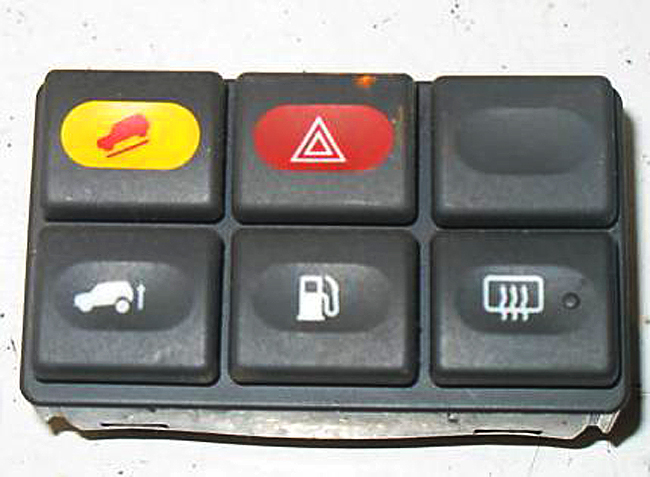
Cars traditionally have very generic button clusters, like [0]. It is even very common to have dummy buttons in there. Combine that with today's cars where those buttons are hooked up to some MCU to send a CAN message instead of being hardwired to a function-specific cable in a giant loom, and it is suddenly quite easy to change button functionality quite late in the design process for basically zero cost: you just need a slightly different label print and a small firmware patch!
Or, if you want to be 100% flexible, go with the ATM approach where physical buttons are placed next to an icon shown on a screen[1]. All of the flexibility and all of the tactile feedback! You can even go for a multi-level layout, with a top row of mode selection buttons, a bottom row of mode-specific function buttons, and perhaps even a big fat dial with haptic feedback[2]. Or even go all-out Elgato Stream Deck[3].
And sure, the fact that slapping in a giant touchscreen lets them decouple UX design from physical controls is going to play a big role. But it is by far the laziest and least user-friendly way of doing so. If that's the best you can come up with, you probably shouldn't be doing UX design at all.
It's even more in regards to production planning. Building the production pipeline takes long and is inflexible as you need to ensure to pick suppliers which will provide spare parts for a sensible price for the whole lifecycle. Thus you limit capabilities very early in the design cycle.
A software based solution you can finalize last minute and with later updates add extra features. Thus if a competitor provides a feature you don't have to wait years for the next new design, but can deliver based on software development priorities any time, to any series you like (even add after delivery)
The idea that Builder.ai was Indian workers being sold as AI wasn’t true, by the way. That was made up by a crypto influencer on twitter and copied by sloppy news sites. They were a consulting firm that also sold an AI product, with the two clearly separated.
I’m not sure if this is the point you mean to make, but Michio Kanu is one of the bigger cranks in physics communication. He said ion an (maybe the Joe Rigan interview?) that quantum computers would be able to act as a truth detector for AI. He wrote a whole book on quantum computing in fact despite clearly not understanding it at all[0].
I’m not sure where this belief came from, or why the people who believe it feel so strongly about it, but this is not generally true.
With the exception of GPL derivatives, most popular licenses such as MIT already include provisions allowing you to relicense or create derivative works as desired. So even if you follow the supposed norm that without an explicit license agreement all open source contributions should be understood to be licensed by contributors under the same terms as the license of the project, this would still allow the project owners to “rug pull” (create a fork under another license) using those contributions.
But given that Zed appears to make their source available under the Apache 2.0 license, the GPL exception wouldn’t apply.
Indeed, if you discount all the instances where it is true, it is not true.
From my understanding, Zed is GPL-3.0-or-later. Most projects that involve a CLA and have rugpull potential are licensed as some GPL or AGPLv3, as those are the licenses that protect everyone's rights the strongest, and thanks to the CLA trap, the definition of "everyone" can be limited to just the company who created the project.
Good catch on the license in that file. I went by separate documents in the repo that said the source is available “under the licenses documented in the repository”, and took that to mean at-choice use of the license files that were included.
I think the caveat to the claim that CLAs are only useful for rug pulls still important, but this is a case where it is indeed a relevant thing to consider.
Don’t make tools for cheating at games against real people. It’s antisocial.
—-
Cheating at games is antisocial. This means it is a behaviour that leads to a worse experience for a community of people to the benefit of those breaking the norms. For example, theft is antisocial.
I consider tools that make are dedicated to making antisocial behaviour easier to carry the same moral weight as the antisocial activity itself. Therefore I consider this tool to be antisocial, as is its creation.
Do you have an intent for this that doesn’t involve that antisocial behaviour, such as research or debugging? Or was that your intent?
At first I was a bit confused why this was a big deal given that Cosmogenic Radionuclide Dating[1] (which is based on cosmic rays) has been a thing for a while. But it turns out this uses an entirely different cosmogenic method based on atmospheric carbon (combined with Dendochronology from the tree rings). Very cool!
Not really, no. That's motivated by not getting impractically small gradients on the plateaus and spoiling the optimization properties when used for deep ANNs.
The sigmoids it replaced had a bit more neuroscience inspiration, but so oversimplified it's just barely.




It means the UI can be designed and developed mostly independently of the physical controls, which helps reduce rework. I also expect it reduces costs for manufacture and assembly.
I’m in favour of more physical controls, but it surprises me that this rarely comes up. I suppose “people are idiots” is a more appealing explanation.
reply