Just shows how quickly and thoroughly those stupid suits managed to destroy its reputation. Guess they love burning money or really needed those tax writeoffs.
It's very confusing topic. I rendered this visual map to show how SRY gene is the 'trigger' for development, not just having the Y chromosome. It helps see the signaling steps where things like AIS or XX syndrome happen: https://vectree.io/c/y-chromosome-genomic-signaling
The question comes down if the presence of the SRY gene impact athletic ability. From my reading, it seems very much like an ongoing research topic.
I recall a study looking at genetics in general and how much of professional sport abilities that can be attributed to it, and the number were fairly high for most sports, especially those involving strength and endurance. Genetic disorders like AIS could however also be a hindrance.
I do recall that in some endurance sports, certain genetic disorders involving oxygen delivery were much more common in top elites than in the average population, meaning that people without that disorder is at severe disadvantage compared to general population. It is an ongoing discussion if people with those kind of disorders should be allowed to compete in for example long distance skiing, as the disorder becomes natural doping and would be cheating if a person without the disorder was competing with that kind of blood in their system.
Genetic testing, outside of the culture war about what defines a man or a woman, really comes down to what is fair competition. Personally I can't really say. Does knowing that maybe half of the top skiers has a rare blood disorder make it less fun for people?
They haven't pierced the corporate veil as far as I can tell - it's not moot or any other executives that have been personally fined. Also as far as I'm aware the UK doesn't have debtors jail.
Because that symbol was used as a notation symbol in those star charts and azimutal maps?
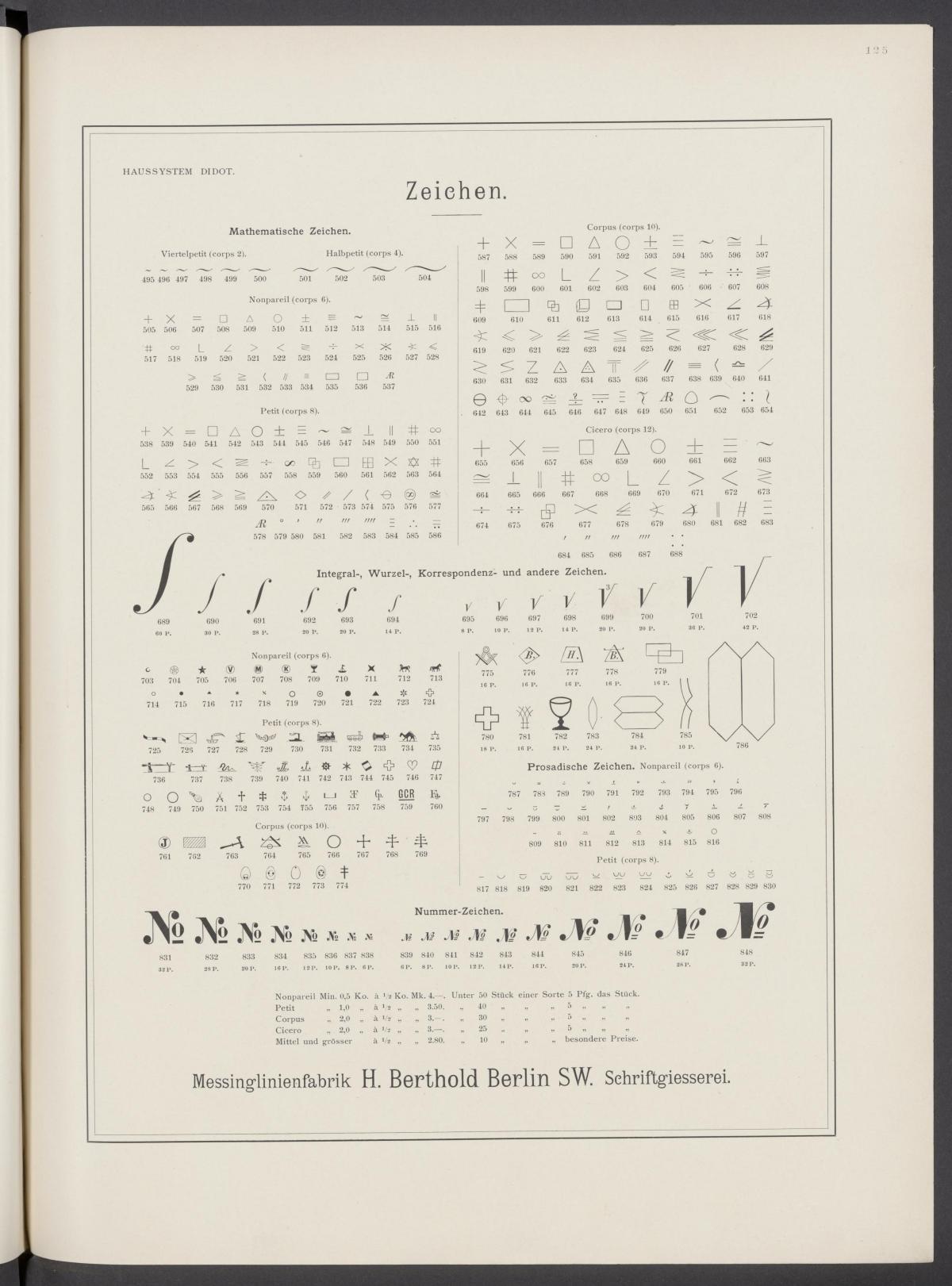
The article quotes the Didot system, specifically, which focused on printing travel maps and is known not only in the French speaking world for its timely accuracy [1] as it was also using that very same map system.
I'm sorry, but I don't understand your comment at all. The linked article does not refer to Didot, nor does the Wikipedia page for the glyph in question.
Neither the wikipedia page for the Didot family, nor for Histoire générale des voyages shows the Angzarr symbol, I've carefully checked on all the scans on these pages. In fact, any occurrence of the symbol would pre-date the current earliest known example (1963) by 200 years, and that would be a great find. If you have an actual reference, please let us know!
Check the photos in the article, specifically this one [1]
"Haussystem Didot", the title of the catalog, refers to a letter setting by the printing agency Didot, which is the one I linked on wikipedia.
The Gallica scans are linked in the wikipedia article. Each of those chapters has hundreds of pages.
I highly doubt that you eye scanned thousands of pages in French handwritten and mixed typesetted ... within less than a day. You definitely must be lying, they take months to read.
> The Gallica scans are linked in the wikipedia article. Each of those chapters has hundreds of pages.
I went through a bit of it and saw no instance of the symbol. If it's in there, would you mind saying which chapter and which page? Or some hint about what context people could find it in? The maps I saw (maps were pretty easy to find, too, since most of the page numbers for them are "NP") didn't seem to use this symbol.
Neither did I read all these pages nor did I pretend to.
> Neither the wikipedia page for the Didot family, nor for Histoire générale des voyages shows the Angzarr symbol, I've carefully checked on all the scans on these pages.
You have linked these two Wikipedia pages[1][2], implying that they confirm your extraordinary claims of how obvious and well-known this symbol is. I could in fact check within a single day that the symbol does not appear on any of the 15 images linked in these pages.
So unless you can produce evidence for your claim that "that symbol was used as a notation symbol in those star charts and azimutal maps?", it is quite disingenuous to expect anyone to take it seriously. Expecting someone else to read "thousands of pages" to confirm or deny YOUR claim makes it even less worthy of consideration.
If you do have actual, material evidence for your claims, everyone in this thread would very much like to see it.
That's great and all, but the point is that there still isn't a single known (to the community of people trying to find the origins of that symbol, so, safe to say, the vast majority of people in general) appearance of the character in the actual text (i.e. used for its purpose), so if you have an example of a map/book/anything where this character was used, providing the link/scan/photo would be very appreciated.
Hmm the comment was a bit difficult to parse, but I think they got it correct. Remember that we have arbitrarily defined the time during local winter as the "standard" time. If we want to keep to that then "permanent daylight savings" is a contradictory term. So what is actually meant is abolishing DST while at the same time changing the standard time to be at the offset of DST before the change. So what I think they are saying is that DST is being abolished, but the actual effective offset at the time when it's abolished is unchanged.
That semantic confusion between daylight saving the switch, and daylight saving the offset, makes it perpetually confusing to argue about whether we should preserve daylight saving at all.
According to wikipedia they are cultivated from a hybrid of mandarin orange and Ichang papeda, the latter being from another wild lineage than the three shown.
You might need several more dimensions (assuming this quoted claim is correct - it does come with a Citation Needed)
> Recent genetic analysis shows the papedas to be distributed among distinct branches of the Citrus phylogenetic tree, and hence Swingle's proposed subgenus is polyphyletic and not a valid taxonomic grouping, but the term persists as a common name.
> The output should be encoded as a pretty JSON string.
So apparently that is what they consider "pretty JSON". I really don't want to see what they would consider "ugly JSON".
(I think the term they may have been looking for is "pretty-printed JSON" which implies something about the formatting rather than being a completely subjective term)
It sounds plausible, but they really need to spell out exactly what the formatting requirements are, because it can make a huge difference in how efficiently you can write the json out.
> An adult in a bathing suit exposed to 1 minimal
erythemal dose of ultraviolet radiation (a slight pinkness to
the skin 24 h after exposure) was found to be equivalent to
ingesting between 10,000 and 25,000 IU of vitamin D
(Fig. 6).
Doesn't say 30 minutes, but it may be 30 minutes depending on your skin colour and the local strength of the sun.
I think the OP's interpretation of this is wrong. Just because someone was found to have an equivalent of ingesting so and so much, after UV radiation, doesn't automatically imply that it a good idea to ingest any amount of vitamin D. Ingestion is different from exposing skin to UV/sun. The paper probably doesn't state, that ingesting that much will make a person absorb that much from that ingestion, nor does it state, that ingesting some equivalent amount will be safe and without side-effects.
So the paper may be well researched or whatever, but the interpretation of it is questionable.
I can't make any assesment on the quality of the paper as that is far outside my expertise, but as far as I can tell from a quick skim it does indeed make the claim that recommendations for supplements should be significantly increased.
From the abstract:
> The safe upper limit for children can easily be
increased to 2,000 IU of vitamin D/day, and for adults, up
to 10,000 IU of vitamin D/day has been shown to be safe.
The goal of this chapter is to give a broad perspective about
vitamin D and to introduce the reader to the vitamin D
deficiency pandemic and its insidious consequences on
health that will be reviewed in more detail in the ensuing
chapters
The full article is available on researchgate[1]. Direct link to PDF [2].
EDIT: I just looked up the author, Michael F. Holick. Apparently he is one the people who identified calcitriol in 1971. I know appeal to authority doesn't prove anything, but it might be prudent to at least consider his findings.